

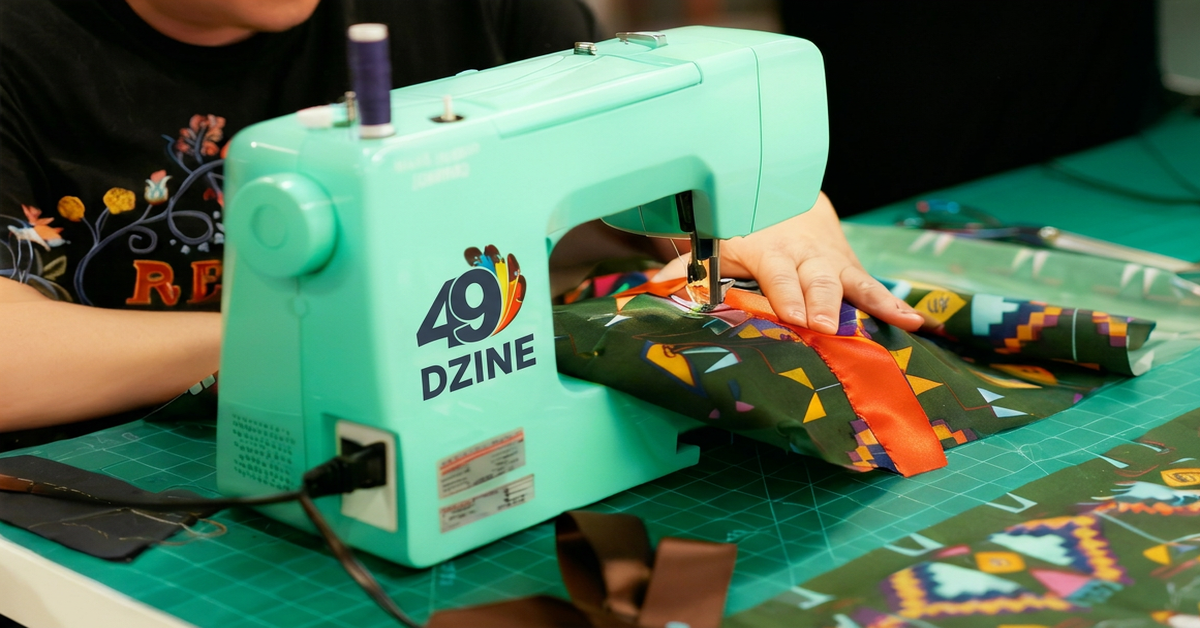
This isn’t a neutral guide. I have opinions about where to buy ribbon skirt fabric and why it matters, and you’re getting those alongside the practical information. Where to find ribbon skirt fabric kits across Canada. Indigenous-owned shops, online ordering, regional tips. Less hunting, more sewing.
What Is a Ribbon Skirt and Why the Fabric Matters
I saw a woman last spring wearing a ribbon skirt with runners and a hoodie, buying groceries, completely unbothered. That would not have been possible for most of my mother’s lifetime. Ribbon skirts were banned under the Indian Act. People burned them. The fact that she can wear one to the store on a Tuesday without thinking twice about it, that took generations to get back.
So I get impatient when people treat ribbon skirt fabric kits like a craft supply question. It’s not just that. What you make this skirt from is a decision. The print, the colours, whose hands designed it, whose community it represents. That’s all part of what the skirt says when you walk into a room wearing it.
In 2024, Anita Cardinal, a Woodland Cree First Nation lawyer from Alberta, wore her ribbon skirt to her call to the bar. She got it from Yellowbird Designs in Edmonton. She didn’t wear it because it matched her robe. She wore it because she was making a point about who gets to take up space in those rooms, and the fabric was part of how she made it. 49Dzine carries Indigenous-designed prints rooted in First Nations artistic traditions and ships across Canada and to the US. I bring them up here because they understand what these skirts are actually for, and it shows in what they make.
What to Look For in Ribbon Skirt Fabric Kits
Most people pick fabric because it looks good. I’ve done it. Pretty is real. But a ribbon skirt is not a throw pillow, and if you’re going to put the time into making one, the design should mean something to you, not just sit nicely against your complexion in the store lighting.
A solid ribbon skirt fabric kit needs base fabric, ribbons in more than one width, elastic, and ideally bias tape and thread. 49Dzine uses cotton poplin. I prefer it over quilter’s cotton because it holds colour after washing, which only matters until you’ve watched a beautiful print go flat and chalky after three washes. You’re wearing this to ceremony. It needs to last.
On ribbons: narrower near the waist so the fabric curves properly, wider near the hem for weight and movement. The 1.5-inch satin is what most makers use. 49Dzine also prints Indigenous designs directly onto their satin ribbon. The ribbon itself carries the design rather than just sitting on top of it. I haven’t seen many suppliers do that.
Indigenous-Owned Fabric Shops and Online Stores in Canada
My preference is always to buy in person from an Indigenous-owned shop when I can get there. You find prints that aren’t listed anywhere online. You have conversations that change what you were planning to make. I’ve walked out of local shops with completely different fabric than I went in for, and the skirt was better for it.
But I live somewhere with options. A lot of makers are hours from anything useful, and driving two hours each way for fabric that might not even be in stock is not a plan.
Facebook Marketplace is a disaster for this. I’ve heard the same story so many times. You pay, you follow up, you get a runaround, the ceremony is in two weeks, and the fabric is just gone. It keeps happening because there’s no accountability and people are desperate enough to try anyway. Don’t do it.
49Dzine has been shipping online for over ten years and they follow through. Order from 49Dzine.com and you get an authentic First Nations designed pattern, actually delivered. That sounds like the minimum, but given what’s out there, it isn’t.
Major Canadian Fabric Retailers That Carry Ribbon Skirt Supplies
Fabricland is not my first recommendation. It’s not my second. But if you’re in a smaller community and there’s nothing else accessible, it gets the job done. Quilter’s cotton, satin ribbon in different widths, elastic, bias tape. The pieces are there.
Go to the ribbon section first. 1.5-inch satin, mid-weight broadcloth. Under $40 for the basics. It won’t be the same as starting with a print designed by an Indigenous artist, and I’m not going to pretend otherwise. It matters. But sometimes you need to start, and you can always work 49Dzine ribbon or printed satin in later. The skirt doesn’t have to come together in one shopping trip.
Before you drive anywhere, call a local quilt shop. Some carry small-run Indigenous-print cotton that never makes it to the chains. Worth ten minutes.
Best Places to Buy Ribbon Skirt Fabric Kits Online in Canada
For makers in the north, or anywhere without a fabric store in reasonable distance, online isn’t a preference. It’s just how it works.
49Dzine is where I’d start. New designs almost every season, plus a made-to-order option for older prints. If something sold out in stores, you can usually still get it. Canada and US shipping.
Bead & Powwow Supply sells full kits. Fabric, ribbons, elastic, bias tape, thread, one box. You open it and start cutting. If you’ve never made a ribbon skirt before and you’re working toward a date, a full kit is the smarter call. Less to track, less that can go sideways before you’ve sewn a single seam.
Etsy Canada takes care. Filter by Canadian sellers, read the about page, check reviews before you buy. And order early. National Ribbon Skirt Day is January 4th every year and every year without fail, the same posts appear in the community groups in late December. People waited too long, shipping backed up, things sold out. Get ahead of it.
Ribbon Skirt Fabric by Province: Regional Sourcing Tips
Over 634 First Nations in this country, each with its own designs, its own protocols, its own visual language. The ribbon skirt tradition runs across many nations but it isn’t uniform. What’s appropriate in one community isn’t automatically right in another. Where you source your fabric is part of that same consideration. It’s not separate from the making.
49Dzine builds their stores around the communities they’re actually in, not just wherever the real estate worked out. Two Alberta locations right now, Calgary and Edmonton, with a third coming. Each one runs Craft Making Experience classes. Learning alongside other people is different from watching a tutorial alone at home. You pick up things you don’t even know you’re picking up.
British Columbia: Indigenous art collectives and craft fairs in Vancouver and Victoria for Coast Salish and Pacific Northwest prints. 49Dzine ships there for a wider range.
Prairies (AB, SK, MB): Two 49Dzine storefronts in Alberta. Active sewing communities in Saskatoon and Winnipeg. Prairie makers are better resourced than most of the country right now, honestly.
Ontario, Quebec, Atlantic Canada: Urban fabric districts cover the basics. For Indigenous-designed fabric, 49Dzine.com is the most reliable option I know of. Mi’kmaq and Wolastoqiyik makers in the Atlantic, check in with your Friendship Centre before ordering anywhere online. Someone there usually has exactly the contact you need.
Northern Communities: You’re ordering by mail. Co-order with other makers to split the shipping. Give yourself more time than seems necessary, and then more than that.
DIY vs. Ready-Made Ribbon Skirt Kits: Which Is Right for You?
Sourcing your own fabric and ribbons is more satisfying. I believe that. Choosing every piece, knowing why you picked each one, that’s part of the making. But it takes time and some familiarity with what you’re looking at, and if you’re new to this, a kit removes enough friction that it can be the difference between starting and not starting.
Before you order anything, settle your cut. An A-line is slimmer and more structured, better for ceremony and formal occasions. A box cut has more room and moves better for dancing. The yardage differs and getting it wrong means running short or ending up with fabric you can’t use. Decide before you order.
49Dzine kits come with fabric, satin ribbon, and elastic, already coordinated. The printed satin ribbon is sold separately if you want it. For sourcing your own, 49Dzine.com first. Seasonal releases plus made-to-order for older prints. Designed by Indigenous artists. That’s the whole point of sourcing carefully.
Community Resources, Workshops, and Where to Learn More
The skirt doesn’t start with the fabric.
It starts in a conversation with someone who’s been making these for years and knows things that aren’t written anywhere. Watching how she pins before she cuts. Hearing what she says about colour and why it matters in the context you’re making this for. A kit insert doesn’t teach you that. Neither does a tutorial. You have to get yourself into the room with people who know.
Friendship Centres run ribbon skirt workshops, especially before January 4th. Call yours. Ask what’s on. Sometimes materials are covered.
49Dzine in Calgary and Edmonton runs Craft Making Experience classes. I’d go even if you already know how to sew. The technique is one part. The rest is about making something that connects to where you come from, and that’s a different kind of learning than getting your tension right.
Search #ribbonskirt on Instagram and TikTok. Makers at every level, sharing their process and their mistakes and their finished skirts. It’s worth being in that.
When yours is done, put it out there. Tag 49Dzine, Yellowbird Designs, whoever you sourced from. A ribbon skirt in public is not a small thing. It never was.
Your Skirt, Your Story
Pick fabric that means something. A skirt made from something that matters to you will feel different to wear than one made from whatever was in stock.
49Dzine storefronts in Calgary and Edmonton. 49Dzine.com for Canada and US. Local Fabricland if that’s what’s there right now. Start somewhere.
This tradition came back from a lot. Your skirt is part of how it keeps coming back.

Leave a comment
This site is protected by hCaptcha and the hCaptcha Privacy Policy and Terms of Service apply.